| Pick Pockets | Open Locks | Finding and Removing Traps | Setting Traps | Moving Silently |
| Hiding in Shadows | Hear Noises | - | Climbing Walls | Back Stabbing |
| The Thief | - | Dragon magazine | - | 1e AD&D |
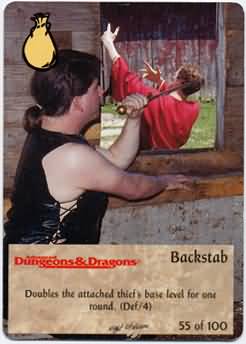
The damage done per
hit is twice normal for the weapon used per four
experience levels of the thief,
i.e. double damage
at levels 1-4,
triple at 5-8,
quadruple at levels
9-12, and
quintuple at levels
13-16.
Note that striking
by surprise from behind also increases the hit
probability by 20% (+4 on the thief's "to hit" die roll). (DMG)
Q: Can thieves back-stab
or assassins
assassinate with missile
weapons?
A: Thieves cannot
use missile weapons for
back-stabbing attacks, but
assassins apparently
can do so (going by a strict
rules
interpretation), though this
is not recommended.
(139.67)
Q. Does a thief's
backstabbing bonus
apply to missile fire from
behind?
A. No. The attack
is treated in the same
manner as a rear missile
attack by
anyone else. A thief
would not cause
double damage with a missile
attack
from behind. The backstabbing
attack
of thieves can only be carried
out
with melee weapons, and represents
a thief's ability to sneak
up behind a
potential victim and strike
for maximum
effect.
(Imagine #19)
Q: If a thief using
two weapons
makes a back attack, does
he get his
"to hit" and damage modifiers
for
both weapons?
A: The + 4 "to hit"
and the damage multiplier
only apply to the first blow;
the second
weapon gets the +2 "to hit"
modifier for a
rear attack but no damage
modifier. The
same holds true if the thief
gets multiple
attacks due to surprise.
(139.67)
Q: When a thief makes
a back attack,
are any damage bonuses for
strength or a magical weapon
also
multiplied?
A: No. The multiplier
applies only to the
weapon's base damage; other
damage
bonuses are applied after
the multiplication
is made.
(139.67)
Q: Can a thief ever
get more than
quintuple damage for back-stabs?
A: No. Quintuple damage
is the limit.
(139.67)
Dispel Confusion: Backstab +
ADQ: When a thief successfully
sneaks up
to a victim and backstabs,
should there
not also be a surprise roll?
As the thief
truly did surprise the opponent,
and
other character classes in
this situation
would have the chance to
attack in each
surprise segment gained,
why not the thief?
or is maximum surprise assumed
-- modified by dexterty?
ADA: The degree of
surprise is not assumed.
At the 1st confrontation,
the thief
gains the backstab bonuses
(+4 "to hit"
& multiplied damage)
only if a standard
roll indicates surprise.
If the victim is not
surprised, only the +2 bonus
"to hit" from
behind applies to the backstab
attempt, and
multiple damage is disallowed,
since it is
contingent on surprise. Assuming
surprise,
multiple attacks may be possible
(as per
normal surprise rules); if
so, the +4 "to
hit" bonus applies for all
such attacks, but
only the 1st gains the multiplier,
as the
victim who has been hit once
does not remain
surprised per se. Another
backstab
attempt against the same
victim may be
made by a different thief,
or by the same
thief if he or she disengages,
departs, and
successfully gains surprise
upon returning.
Surprise is not possible
if the victim is
aware of the thief's presence
and position.
(Polyhedron #31)
TheDungeonDelver wrote:
Gary: Backstab rule in 1e
- meant to be melee only, or can it work ranged (e.g., "sniper fire")?

Not for a Thief--hand-weapon
strike only in such case.
For an Assassin
i would allow it.
Back Stabbing:
Opponents aware of the thief will be able to negate the attack form.
Certain creatures (otyughs,
slimes, molds, etc.) either negate surprise or have no definable "back",
thus negating this ability.